Key to remember:
FMLA leave abuse investigations must be individualized
02/11/2026
Giving certain conditions a free pass can risk a violation
Employees who abuse leave under the federal Family and Medical Leave Act (FMLA) risk losing their job protections under the law. Employers must be careful, though, when determining whether employees are abusing their leave. One employer learned this through a court case.
The backdrop
The company required some employees to work on weekends and holidays. It normally called Andrew, an employee, to work on an as-needed basis. He would indicate that he was available for work by “marking up” for it, and indicate when he wasn’t available for work by “marking off.”
The employer assessed attendance points when employees marked off as sick, which could lead to discipline. The employer, however, didn’t assess points if employees took FMLA leave. Employees weren’t supposed to use FMLA leave to avoid working on weekends or holidays, though.
The company identified employees with a pattern of taking FMLA leave to extend their weekends, vacations, or holidays. Jolanda, the company's senior benefits manager, determined the criteria used to identify employees who were potentially misusing FMLA leave and conducted individualized reviews.
The story
In May 2017, Andrew applied for intermittent FMLA leave for major depression and insomnia. Andrew’s doctor estimated that he would need to take intermittent FMLA leave once a month for up to 2 days per episode. The company approved the leave.
In August, the company sent Andrew a warning letter after he used FMLA leave on 4 weekends over a 6-week period. The letter stated that it appeared he was misusing FMLA leave, as he had a pattern of marking off FMLA leave on the weekends, or in conjunction with vacations or holidays. The letter further stated that continued FMLA misuse could lead to discipline.
As the holidays approached, about 10 percent of the workforce marked off for Christmas morning. Because of this, Jolanda believed that some employees were using FMLA leave dishonestly and investigated the cases. Jolanda didn’t, however, include employees who had cancer, were terminally ill, or were about to give birth, as she deemed these conditions justified using FMLA leave.
She investigated Andrew because he took FMLA leave from the day before Thanksgiving until the day after Thanksgiving, when he had the first of 2 scheduled rest days. He also took FMLA leave on Christmas Eve and Christmas Day, followed by 2 consecutive rest days, and again on New Year’s Eve and had New Year’s Day off as a vacation day. The employer accused him of misusing FMLA leave and eventually fired him. He sued.
In court
Andrew claimed that the employer violated the FMLA when it fired him for taking FMLA leave over Christmas and New Year’s Eve. He argued that holidays worsened his condition, justifying his need for leave. He also argued that the investigation into him wasn’t reliable, since Jolanda didn’t include employees with other conditions in her investigations.
In denying the employer’s request to throw the case out, the court said that the company’s systematic better treatment of similarly situated employees with other serious health conditions was evidence that would allow a jury to infer that its disciplinary action against Andrew was retaliation for taking FMLA leave on holidays.
Brown v. CSX Transportation, Inc., District of Florida, No. 8:24-cv-2777, January 23, 2026.
Watching for FMLA leave misuse patterns can be useful, but when employers take disciplinary action without an individualized review (or apply policies inconsistently) their actions can risk crossing the line into retaliation.
This article was written by Darlene M. Clabault, SHRM-CP, PHR, CLMS, of J. J. Keller & Associates, Inc. The content of these news items, in whole or in part, MAY NOT be copied into any other uses without consulting the originator of the content.
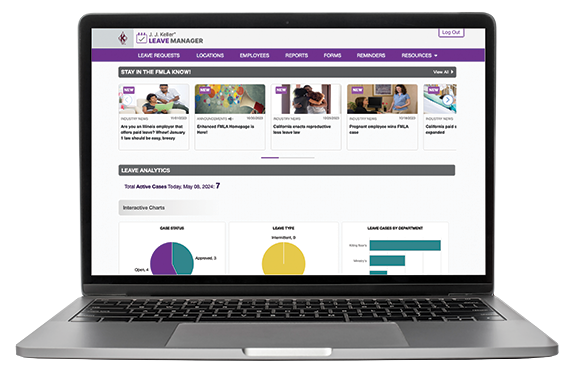
The J. J. Keller LEAVE MANAGER service is your business resource for tracking employee leave and ensuring compliance with the latest Federal and State FMLA and leave requirements.